
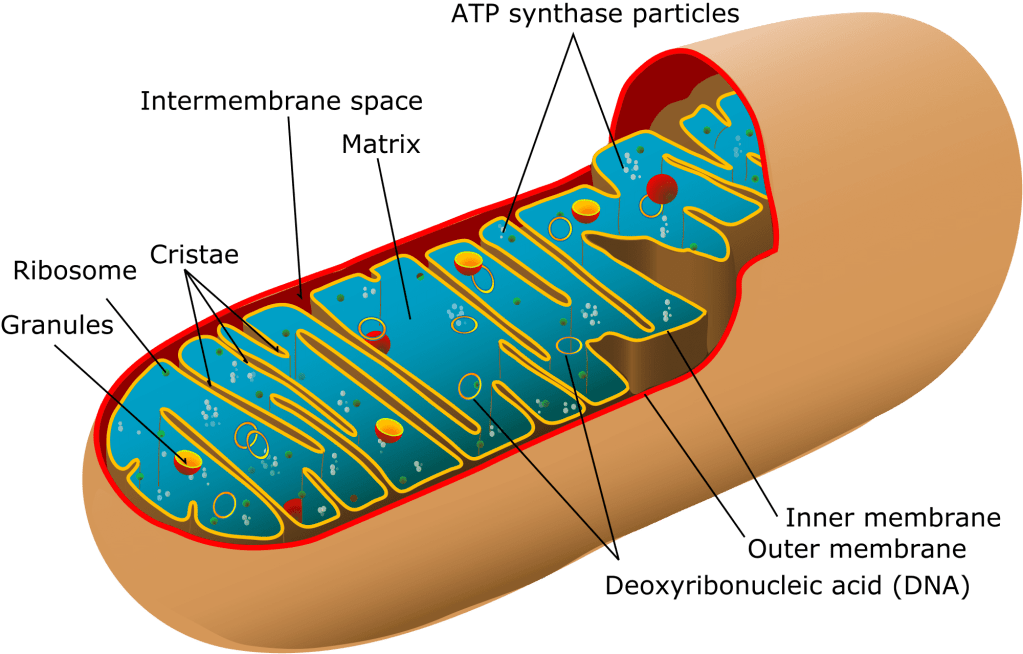
Mitochondrial DNA (mtDNA) is a small, circular piece of DNA located inside the mitochondria of a cell, which are organelles responsible for producing energy within the cell; it is inherited solely from the mother and is distinct from the larger nuclear DNA found in the cell nucleus.
Key points about mitochondrial DNA:
- Function: Mitochondrial DNA carries genes essential for the proper functioning of the mitochondria, which are crucial for cellular energy production.
Inheritance:
Unlike nuclear DNA which is inherited from both parents, mitochondrial DNA is only passed down from the mother through the egg cell.
Structure:
mtDNA is a small circular chromosome containing a limited number of genes compared to nuclear DNA.

Applications:
Due to its maternal inheritance pattern, mitochondrial DNA is widely used in genetic studies for tracing ancestry and evolutionary lineage.
A diagram of mitochondrial DNA would show a small, circular, double-stranded molecule with distinct regions including the “heavy strand” and “light strand”, containing genes for 13 protein-coding sequences, 22 transfer RNAs (tRNAs), and 2 ribosomal RNAs (rRNAs), with a prominent non-coding region called the D-loop where replication is initiated; essentially depicting a compact circular structure with clearly labeled functional components within it.
Key points to include in the diagram:
- Circular structure: Mitochondrial DNA is a closed circle, unlike the linear chromosomes in the nucleus.
Heavy strand (H-strand):
The outer circle of the DNA, typically depicted as a thicker line, containing most of the protein-coding genes.
Light strand (L-strand):
The inner circle of the DNA, containing the remaining protein-coding genes and some tRNA genes.
D-loop region:
A non-coding region where replication begins, often shown as a distinct loop structure.
Gene labels:
Indicate the locations of the 13 protein-coding genes (e.g., part of the electron transport chain), 22 tRNA genes, and 2 rRNA genes.
Important considerations:
- Scale: Since the mitochondrial genome is relatively small compared to nuclear DNA, the diagram should accurately represent the relative sizes of different regions.
Color coding:
Use different colors to distinguish between the H-strand, L-strand, and different gene types (protein-coding, tRNA, rRNA) for clarity.
Structure of DNA


 Reality is Dharma